
Attic Insulation and Air Sealing
Our local roofer seals attic air leaks and adds insulation on North Branch homes. The gaps around lights, pipes, flues and the hatch are sealed first. Then insulation goes across the attic floor, with the soffit vents kept open. The target for an uninsulated attic here is R60.
Why Air Sealing Comes Before Attic Insulation
Air sealing comes before attic insulation because warm, moist air leaking up through gaps in the ceiling carries heat straight past the insulation. That air leakage is the major cause of ice dams in many homes.
The long-term fix is to make the ceiling airtight first, so no warm, moist air can flow from the house into the attic. Only then should you consider adding ceiling or roof insulation.
Insulation laid over open leaks still lets that air through, and once it is down the leaks are buried and hard to reach. For the roof's part in stopping ice dams, see ice dam prevention.
Order of work
Seal, then insulate
Seal the ceiling first and add insulation second.
How Much Attic Insulation a North Branch Home Needs
A North Branch home needs attic insulation of about R60 if the attic has none. If it already has 3 to 4 inches, top it up to R49. These targets are for climate zone 6, the zone Minnesota's energy code assigns to Chisago County.
Chisago County is zone 6A under the Minnesota Energy Code. The same targets apply to zones 7 and 8 further north.
| What the attic has now | Target | Notes |
|---|---|---|
| No insulation | R60 | For existing wood-framed homes in zone 6 |
| 3 to 4 inches | Add to reach R49 | Same zone; add on top of what is there if it is dry and clean |
| Wet, moldy or matted insulation | Fix the cause first | Consult a professional before insulating |
Air sealing and insulating attics, crawl space floors and basements is estimated to save homeowners an average of 15% on heating and cooling.
Want our local roofer to take a look?
Send a few details or call (651) 427-2051, and our local roofer will come and look.
Attic Problems to Fix Before Adding Insulation
The attic problems to fix before adding insulation are wet or damp insulation from a roof leak, moldy or rotted rafters or joists, bathroom, kitchen or dryer vents that blow into the attic, little or no attic ventilation, and old knob and tube wiring.
These conditions call for a professional before insulating. A roof leak goes first: see roof leak repair.
- Wet or damp insulation, a sign the roof is leaking
- Mold or rot on rafters or floor joists
- Bathroom, kitchen or dryer vents ending in the attic
- Little or no attic ventilation
- Knob and tube wiring, found in homes built before about 1930
Frost on the nails?
Moist air is leaking
Winter frost under the roof deck means house air is reaching the attic.
How an Attic Is Air Sealed and Insulated
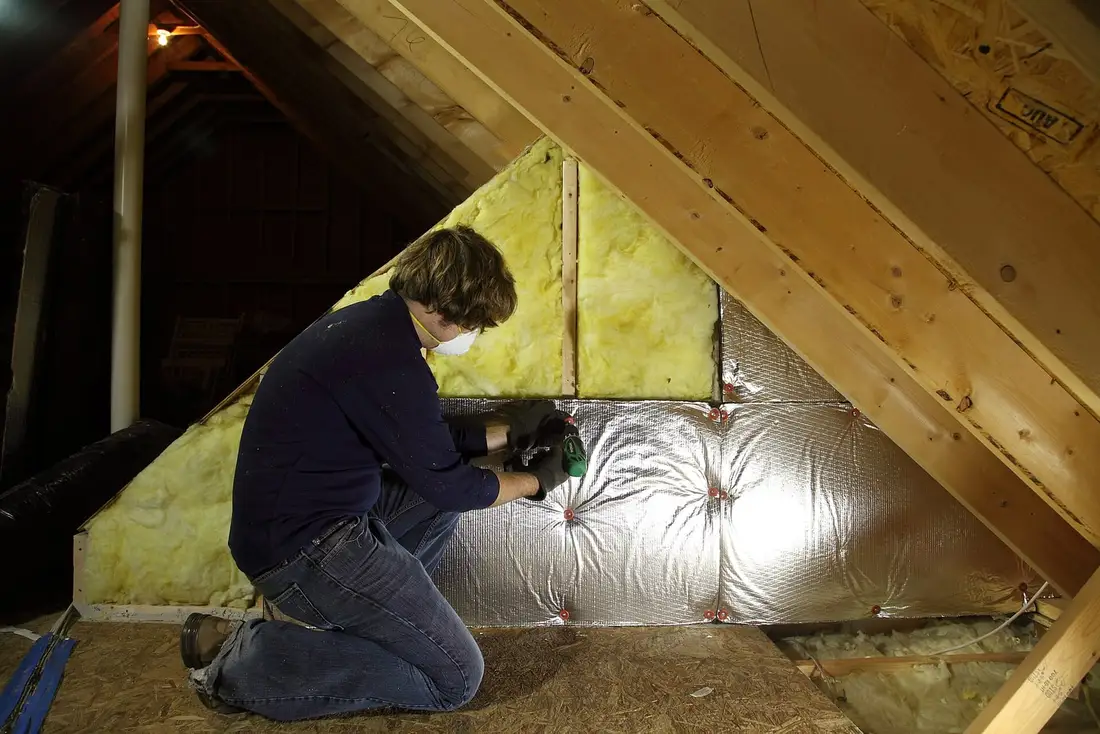
An attic is air sealed and insulated by testing the house for leaks, sealing the openings in the attic floor, fitting baffles so insulation cannot block the soffit vents, blowing or laying insulation to the target depth, and checking that gas appliances still vent safely afterwards.
- 1
Test for leaks
A contractor should run a blower door test and may use an infrared camera to find where warm air escapes.
- 2
Seal the attic floor
Gaps around light fixtures, plumbing stacks, wiring holes, chimneys, flues and the hatch are sealed.
- 3
Keep the vents clear
Minnesota's code requires at least a 1-inch air space between insulation and roof sheathing at eave vents; see roof ventilation.
- 4
Add insulation
Never cover soffit vents, and keep insulation 3 inches from recessed lights unless they are rated IC.
- 5
Check combustion air
Sealing can make naturally venting gas appliances back-draft, so their venting is checked once the house is tighter.
What Attic Insulation Costs
Attic insulation with air sealing typically costs $3,000 to $6,500 in Minnesota, with most projects in the middle of that range. Blowing in insulation alone costs about $1.20 to $1.60 per square foot in Minneapolis, or $1,220 to $1,550 for a 1,000 sq ft attic. These are local figures, not a quote.
Spray foam in Minneapolis costs $0.60 to $1.00 per board foot for open cell and $1.10 to $1.60 for closed cell. Nationally, air sealing alone runs $250 to $750, and removing old insulation $1 to $1.50 per square foot. The federal tax credit for insulation and air sealing does not apply to work done in 2026. It is not allowed for any property placed in service after December 31, 2025.
Attic insulation by type
Installed, per sq ft of atticWant a real price for attic insulation?
Our local roofer will look at your roof and give you a written estimate. Send a few details or call (651) 427-2051.
Who Can Insulate an Attic in Minnesota?
An attic can be insulated by a contractor with a Minnesota residential building contractor or remodeler license, or by a weatherization contractor. A roofer-only license covers insulation at the roof, not on the attic floor. Our local roofer handles attic insulation, so ask for their license number when you book.
Minnesota law lists insulation at the roof under roofing, and insulation inside the house under interior finishing. Work that crosses both needs the building contractor or remodeler license.
Weatherization contractors are a good choice for air sealing and blower door testing.
Before you book
Ask for the license number
A roofer-only license does not cover insulation on the attic floor.
Attic Insulation FAQs
Will more attic insulation stop ice dams?
Not on its own. Make the ceiling airtight first and then add insulation, because air leaking into the attic is the major cause of ice dams in many homes. If you have ice now, see ice dam removal.
How much insulation should a Minnesota attic have?
R60 for an uninsulated attic in climate zone 6, or R49 where 3 to 4 inches are already there. Chisago County is zone 6A.
How much does attic insulation cost?
Air sealing and insulating an attic typically costs $3,000 to $6,500 in Minnesota. Blowing in insulation alone runs about $1.20 to $1.60 per square foot in Minneapolis. These are local figures, not a quote.
Should I add a powered attic fan instead?
No. Mechanical attic ventilation is not a recommended fix for ice dams in Minnesota, and it can cause other attic moisture problems.
Is there still a tax credit for attic insulation?
Not for work done in 2026. The federal credit covered insulation and air sealing through December 31, 2025, and it does not apply to property placed in service after that date.
Get an attic insulation estimate
Tell us roughly how much insulation is in the attic now, whether you get ice dams or frost in the attic, and how old the roof is. We pass it to our local roofer, who will tell you how they handle insulation and air sealing.
Call now (651) 427-2051 Roofing in North Branch and the towns around it