
Roof Ventilation
Our local roofer checks and fixes roof vents on North Branch homes. Air should come in at the soffits and out near the ridge, carrying off moisture and keeping the roof deck cold. It works alongside air sealing and insulation.
How Roof Ventilation Works
Roof ventilation works by letting cool outside air enter low through soffit or eave vents and leave high through ridge or roof vents, so air washes the underside of the whole roof deck.
In winter that airflow carries off moisture that gets into the attic and helps keep the deck cold enough that snow does not melt from below. In summer it lets some of the built-up heat out. Intake low and exhaust high is the key; vents at only one level move very little air.
Code baseline
1 sq ft per 150
Minimum net free vent area for each 150 sq ft of attic under Minnesota code.
How Much Attic Ventilation Minnesota Code Requires
Minnesota code requires 1 square foot of net free attic ventilation for every 150 square feet of attic, which can drop to 1 per 300 when a Class I or II vapor retarder is on the warm-in-winter side of the ceiling and 40 to 50 percent of the vent area is within 3 vertical feet of the ridge.
Net free area is the open area a vent actually provides after its screen or louvers, which is less than its outside size.
| Attic floor area | At 1/150 | At 1/300 |
|---|---|---|
| 1,000 sq ft | about 6.7 sq ft of vent | about 3.3 sq ft of vent |
| 1,500 sq ft | 10 sq ft of vent | 5 sq ft of vent |
| 2,000 sq ft | about 13.3 sq ft of vent | about 6.7 sq ft of vent |
The 1 per 150 rule applies where roof and soffit vents are used together. In North Branch, code does not require ventilation to be upgraded or altered when you reroof. Whether to improve it is your call with our local roofer.
Signs of Poor Roof Ventilation
Signs of poor roof ventilation are frost or water drops on the underside of the roof deck in winter, damp or matted insulation, dark staining or mold on attic wood, ice dams at the eaves, and an attic that is very hot in summer.
Many of these signs also point to warm air leaking up from the house, so the roofer will look at both. Ice at the eaves is covered on our ice dam prevention page.
- Frost on nail tips and the underside of the deck in cold weather
- Water drips or stains on attic insulation
- Black or gray staining on rafters and sheathing
- Soffit vents painted over or packed with insulation
- Ice dams and long icicles along the eaves
- Shingles blistering or curling early
Where to look
In the attic
On a cold morning, check the deck and nail tips with a flashlight.
Seeing these signs?
Our local roofer will look at your roof and tell you what it needs. Send a few details or call (651) 427-2051.
Types of Roof Vents
The common types of roof vents are soffit intake vents, ridge vents, box or static roof vents, and gable vents, and a working system pairs low intake with high exhaust.
Soffit vents
Intake vents under the eaves; they only work if insulation is held back with baffles. Worn eaves are a soffit and fascia job.
Ridge vents
A continuous exhaust slot along the peak, covered by cap shingles, that lets warm air out along the whole ridge.
Box vents
Static exhaust vents set near the ridge, used where a ridge vent will not fit.
Gable vents
Louvers in the end walls, common on older homes; mixed with a ridge vent they can short-circuit the airflow.
Should You Add a Powered Attic Fan?
You should not add a powered attic fan to cure ice dams. Mechanical attic ventilation is not recommended, and air sealing the ceiling comes first.
A fan lowers the pressure in the attic, which can pull warm, moist house air up through every gap in the ceiling, the very air you are trying to keep out. Passive intake and exhaust, sized to code, is the usual answer.
Ice dam order
Seal first
Make the ceiling airtight, then insulate, then look at venting.
Fixing Roof Ventilation During a Reroof
Fixing roof ventilation is easiest during a roof replacement, when the roofer can cut in a ridge vent, open blocked soffits, add baffles and balance intake with exhaust while the deck is exposed.
- 1
Measure the attic
The roofer works out the attic area and the vent area needed under the 1/150 or 1/300 rule.
- 2
Check intake
Soffits are opened up and baffles keep insulation from blocking the airflow.
- 3
Set exhaust
A ridge vent or box vents near the ridge are sized to match the intake.
- 4
Close the extras
Mixed exhaust types that fight each other are removed or blocked.
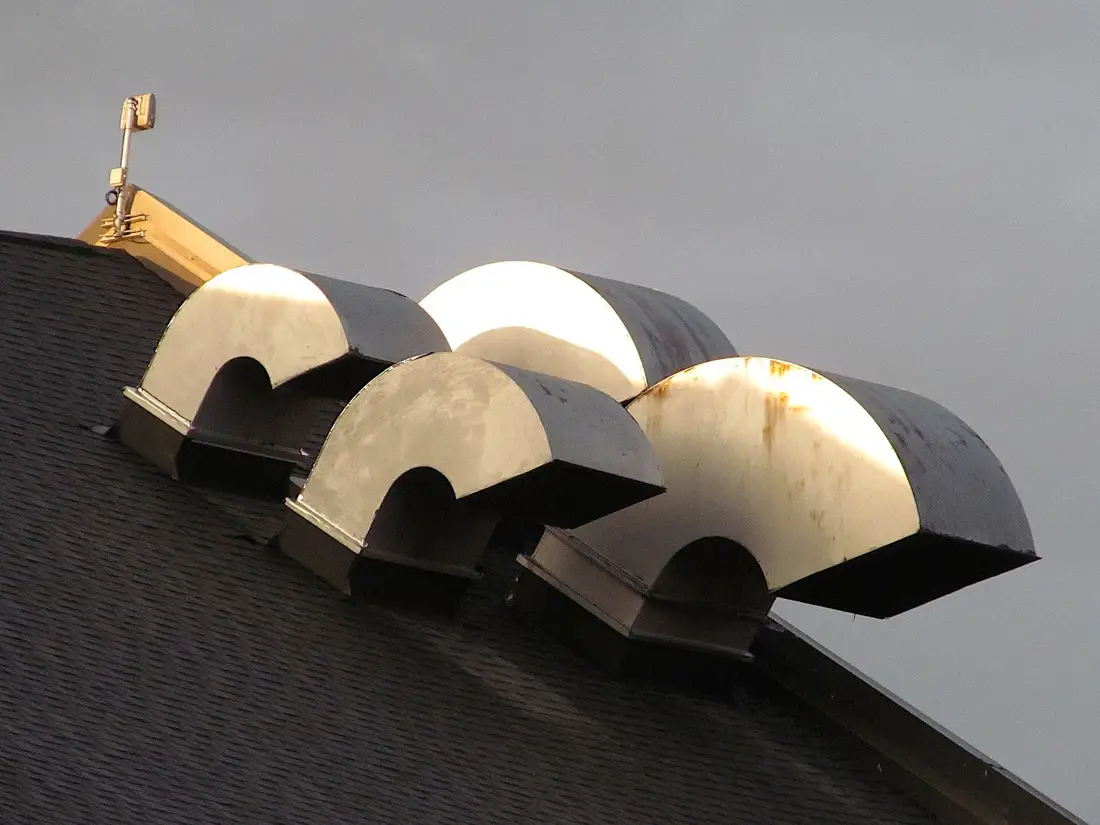
Outside a reroof, roof vent repair runs $75 to $250, a national figure and not a quote. With the shingles off, the roofer can also lay the ice and water shield at the eaves.
Want our local roofer to take a look?
Send a few details or call (651) 427-2051, and our local roofer will come and look.
What Poor Roof Ventilation Leads To
Poor roof ventilation leads to ice dams at the eaves, frost and rot on the underside of the roof deck, and blocked soffits that need replacing, so it is usually fixed alongside those problems.
Roof Ventilation FAQs
How much attic ventilation do I need?
One square foot of net free vent area per 150 square feet of attic, or 1 per 300 when a Class I or II vapor retarder is on the warm side of the ceiling and 40 to 50 percent of the vents are within 3 feet of the ridge.
Do I have to upgrade ventilation when I reroof in North Branch?
No. In North Branch, code does not require ventilation to be upgraded or altered when you reroof. Many homeowners still fix it then because the roof is open.
Will better ventilation stop ice dams?
It helps, but not on its own. Air sealing comes first and insulation second, and mechanical attic ventilation is not recommended.
Can you mix a ridge vent with box or gable vents?
Usually it is better not to. Two kinds of exhaust can pull air from each other instead of from the soffits, leaving parts of the deck without airflow.
What does a roof vent repair cost?
About $75 to $250, a national figure and not a quote. Our local roofer prices it after seeing the roof.
Get a roof ventilation estimate
Tell us what you are seeing in the attic or at the eaves. Our local roofer will check the vents and quote any work needed.
Call now (651) 427-2051 Roofing in North Branch and the towns around it