
Emergency Roof Repair
Our local roofer stops water coming into your North Branch home after a storm, a fallen tree or an ice dam. The first job is a temporary fix to keep the rain out. The permanent repair follows once it is safe.
What Counts as a Roof Emergency
A roof emergency is any damage that lets water into the house now or puts people at risk, such as a tree on the roof, a section of shingles or decking torn off, water coming through a ceiling, or a roof sagging under snow.
A small stain that has not grown is not an emergency; book a normal roof leak repair. Anything structural, near power lines or involving a sagging ceiling is about safety first and the roof second.
Safety first
Stay off the roof
Anyone on a roof in winter risks injury and may damage the roof and house.
What to Do in a Roof Emergency
In a roof emergency, get everyone away from the damaged area, shut off power to wet rooms if you can do so safely, catch the water, document the damage, and then contact a roofer.
Do these in order. Photos taken before anything is moved or covered help both the roofer and your insurer.
- 1
Get clear
Move people and pets away from sagging ceilings, fallen branches and any downed wires.
- 2
Cut power if safe
Turn off the breaker for rooms where water is near lights or outlets, but only if you can reach the panel without standing in water.
- 3
Catch the water
Use buckets and towels, and move furniture and electronics away from drips.
- 4
Photograph everything
Photograph the ceiling, attic, roof and yard, including any branches or debris, before cleanup.
- 5
Send details
Send us the details and photos, and we pass them to the roofer, who arranges the temporary cover and the repair.
What Emergency Roof Repair Costs
Emergency roof tarping averages about $450 nationally, within a range of $150 to $3,300. Emergency tarping costs 50% to 100% more than scheduled work.
The permanent repair is a separate cost. Typical roof leak repairs run $350 to $1,500. These are national figures and not a quote. The roofer prices the job after seeing it.
Emergency and follow-up costs
Whole job, nationalWant a real price for emergency roof repair?
Our local roofer will look at your roof and give you a written estimate. Send a few details or call (651) 427-2051.
Temporary Fix vs. Permanent Repair
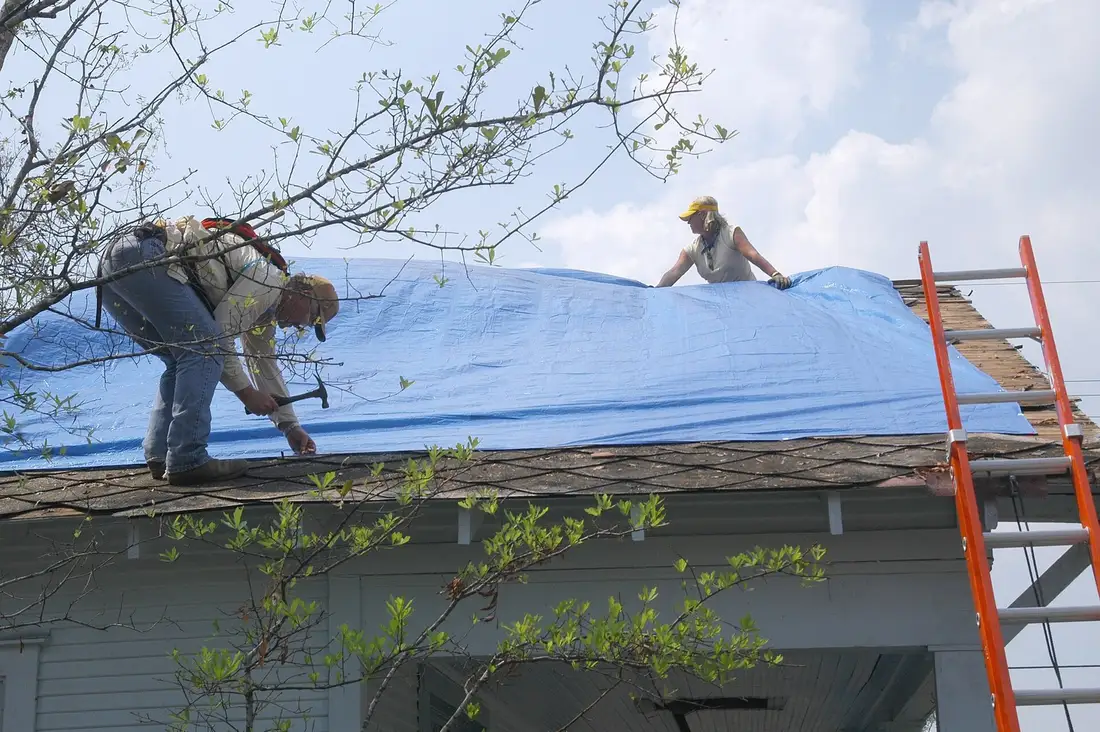
A temporary fix such as a tarp or patch only keeps water out until the roof can be repaired properly, while a permanent repair replaces the damaged shingles, flashing or decking.
Tarps are meant to buy time, not to sit through a season. Once the weather allows, the roofer inspects the deck and decides between a repair and a roof replacement.
Temporary fix
- Tarp secured over the damaged area
- Debris and branches cleared
- Water kept out of the house
- Damage documented for insurance
Permanent repair
- Damaged decking replaced
- New underlayment and shingles
- Flashing reset or replaced
- Inside checked for wet insulation
Signs a Snow-Loaded Roof Is in Danger
The signs that a snow-loaded roof is in danger are a roofline that is no longer straight, ceiling or truss damage, and bulging walls. If you see these, do not climb onto the roof or go into the building.
These warning signs apply to any building, not just farm buildings. Homes in Chisago, Isanti, Anoka and Washington counties are built for a 50 psf ground snow load, and Pine and Kanabec for 60 psf. Heavy wet snow and ice can still be a problem on an older or damaged roof. For removal before it gets this far, see roof snow removal.
- Roofline that sags or is no longer straight
- New cracks in ceilings or drywall
- Cracked or bent trusses in the attic
- Bulging walls
Seeing these signs?
Our local roofer will look at your roof and tell you what it needs. Send a few details or call (651) 427-2051.
Emergency Repairs and Your Insurance Claim
Emergency repairs and your insurance claim go together: document the damage, keep receipts, and know that under Minnesota law a roofer can still be paid for emergency services already performed even if you later cancel the contract after a claim denial.
That same law lets you cancel a roofing contract paid from insurance within 72 hours after the insurer tells you the claim is denied. Our guide to roof insurance claims covers the rest, and storm-specific help is under storm damage roof repair.
Keep records
Photos and receipts
Photos before cleanup and receipts for any tarp or emergency work help when you file a claim.
Emergency Roof Repair FAQs
How much does an emergency roof tarp cost?
An emergency roof tarp averages about $450 nationally, with a range of $150 to $3,300, and emergency work costs 50% to 100% more than scheduled tarping. That is not a quote.
Should I go on the roof to tarp it myself?
No, not in wind, rain, snow or ice. Being on a roof in winter risks injury and can damage the roof, and a wet roof is slippery in any season.
What can I do about an ice dam leak right now?
In an emergency, you can cut channels through the dam with tap water on a warm day, working up from the lower edge. This is only temporary. See ice dam removal for longer fixes.
Will insurance pay for emergency roof repair?
It depends on your policy and the cause of the damage, and only your insurer or a licensed public adjuster can tell you. Minnesota law bars roofers from interpreting your policy unless they hold a public adjuster license.
Can a roofer start emergency work before the insurance adjuster comes?
Yes, temporary work to stop more water getting in is normal before an adjuster visits. Take photos first and keep the receipts so the insurer can see what was there.
Get emergency roof help
Tell us what happened and where water is getting in, with photos if you can take them safely. We pass it to our local roofer, who decides what can be done and when.
Call now (651) 427-2051 Roofing in North Branch and the towns around it