
Ice and Water Shield
Our local roofer installs ice and water shield on every North Branch reroof. It is a self-sticking waterproof membrane laid at the eaves, so meltwater behind an ice dam cannot reach your ceilings. Minnesota code requires it, and the city inspector checks it.
What Ice and Water Shield Is
Ice and water shield is a self-adhering, polymer-modified bitumen membrane that sticks directly to the roof deck and seals around the nails driven through it, forming a waterproof layer under the shingles.
Minnesota code calls it an ice barrier. It allows either that self-adhering sheet or two layers of underlayment cemented together. Ordinary underlayment sheds water; an ice barrier is meant to hold back standing water, which is exactly what an ice dam creates.
Code name
Ice barrier
Minnesota code calls it ice barrier underlayment; roofers often call it ice and water shield.
Minnesota Ice and Water Shield Requirements
Minnesota requires ice and water shield, called ice barrier in the code, on every dwelling, running from the lowest roof edge to at least 24 inches inside the exterior wall line, and at least 36 inches up the slope from the eave on roofs of 8:12 or steeper.
The rule covers all dwellings, structures attached to dwellings, and all heated or cooled structures. Detached accessory buildings with no conditioned floor area are exempt. On a home with deep overhangs, 24 inches inside the wall can mean more than one course of membrane.
What the North Branch Tear-Off Inspection Checks
The North Branch tear-off inspection checks the roof decking. It also confirms the ice and water barrier runs 24 inches up past the exterior wall before the shingles go on.
- 1
Permit
A permit is required to reroof a home in North Branch, pulled by the homeowner or a contractor licensed by the Minnesota Department of Labor and Industry.
- 2
Tear-off
The old roofing comes off down to the deck, which also lets the roofer see any rot.
- 3
Book the inspection
The city asks for a call to 651-674-8113 at least 24 hours ahead.
- 4
Deck and barrier check
The inspector looks at the decking and confirms the ice barrier reaches 24 inches past the exterior wall.
- 5
Final inspection
At the end, all roofing and flashing must be in place.
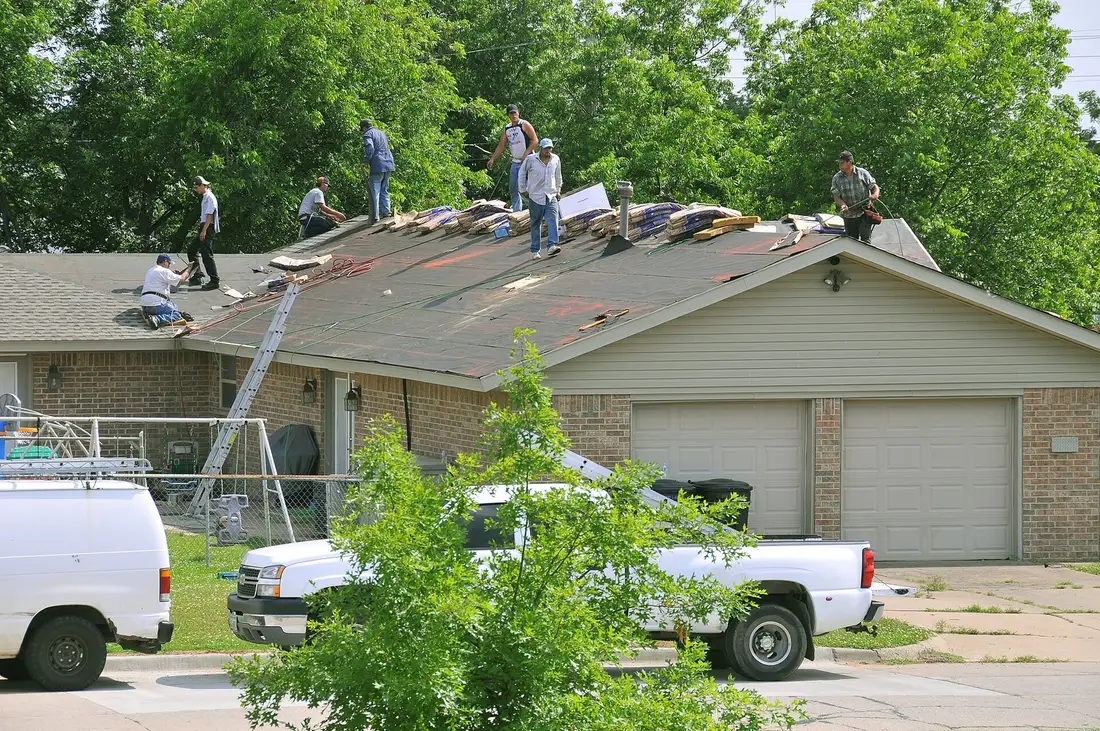
If the inspector or roofer finds soft or rotted boards at tear-off, that becomes roof decking replacement before the barrier goes down.
Want our local roofer to take a look?
Send a few details or call (651) 427-2051, and our local roofer will come and look.
Where Ice and Water Shield Goes on a Roof
Ice and water shield goes along the eaves first, as Minnesota code requires, and roofers commonly add it in valleys, around chimneys, skylights and walls, and on low-slope sections where water moves slowly.
Eaves
The code-required strip from the roof edge to at least 24 inches inside the wall line, where ice dams hold water.
Valleys
Two roof planes dump water into one channel, so a membrane lining under the valley is common practice.
Around penetrations
Chimneys, skylights and sidewalls get membrane under the flashing as a second seal.
Low slopes
North Branch requires two layers of underlayment on slopes from 2:12 to 4:12. It bars asphalt shingles below 2:12.
At the roof edge, the membrane works with drip edge; Minnesota deleted the code requirement for drip edge, though many roofers still fit it.
What Ice and Water Shield Costs
Ice and water shield costs about $0.50 per square foot as a line item on a roof replacement. That is a national figure and not a quote.
That is a small share of a full roof replacement. An asphalt shingle roof costs $5 to $7 per square foot installed in Minneapolis, a local figure and not a quote. Our local roofer prices your roof after seeing it, including any extra courses for deep overhangs or steep slopes.
Line-item cost
$0.50/sq ft
National line-item figure for ice and water shield on a reroof; not a quote.
Signs Your Roof Lacks Enough Ice and Water Shield
Signs your roof lacks enough ice and water shield are winter leaks at the eaves whenever an ice dam forms, water stains along ceilings near exterior walls, and wet or darkened decking above the eaves in the attic.
Older roofs may predate the current rule or have a strip too short for deep overhangs. Ice barrier sits under the shingles, so adding it means removing at least the lower courses; most homeowners do it with a reroof. The code lets an existing ice barrier that is adhered to the deck stay and be covered by a new layer. If you have ice on the roof now, see ice dam removal.
- Ceiling stains near outside walls that show up only in winter
- Drips around window and door tops during thaws
- Dark or soft decking at the eaves, seen from the attic
- A roof older than the current code rule, with no record of a barrier
Best time to fix
At reroof
With the shingles off, the barrier can be laid to code and inspected.
Seeing these signs?
Our local roofer will look at your roof and tell you what it needs. Send a few details or call (651) 427-2051.
What Else Keeps Meltwater Out of a Roof
Besides ice and water shield, meltwater is kept out of a roof by preventing ice dams with air sealing and insulation, by balanced attic ventilation, and by fixing leaks before the deck rots.
Ice and Water Shield FAQs
Is ice and water shield required in Minnesota?
Yes. Minnesota requires an ice barrier on all dwellings, attached structures and conditioned buildings; only detached accessory buildings with no conditioned space are exempt.
How far up the roof does ice and water shield have to go?
At least 24 inches inside the exterior wall line, measured from the lowest roof edge. On roofs of 8:12 or steeper it must also reach at least 36 inches along the slope from the eave.
Does ice and water shield stop ice dams?
No, it does not stop ice dams from forming; it keeps the water they back up from leaking into the house. Stopping the dams is ice dam prevention work: air sealing, insulation and venting.
Can new ice and water shield go over the old one?
Yes, if the old ice barrier is adhered to the deck. Minnesota's code lets it stay in place and be covered with a new layer of ice barrier during a reroof.
Who checks the ice and water shield in North Branch?
The city building inspector, at the tear-off inspection, confirms the barrier is on and runs 24 inches past the exterior wall.
Get a roof estimate
Tell us about your roof and any winter leaks. Our local roofer will look at your roof and quote a reroof with the ice barrier laid to Minnesota code.
Call now (651) 427-2051 Roofing in North Branch and the towns around it