
Roof Flashing Repair
Our local roofer repairs and replaces roof flashing on North Branch homes, around chimneys, vents, skylights, walls and valleys. Many roof leaks start at one of those joints, not in the open field of shingles. They find which piece has failed and fix it.
What Roof Flashing Does
Roof flashing seals the joints where the roof meets something else, such as a chimney, a wall, a vent pipe, a skylight or another roof plane, and turns the water that runs into those joints back out onto the shingles.
Shingles shed water well across an open slope because each course laps over the one below. That lap breaks wherever something pokes through the roof or a wall rises out of it. Flashing is the piece that restores the lap at those spots, so water always runs over a layer, never behind it.
When flashing fails, the leak often shows up some distance from the actual hole, because water runs along the deck or rafters before it drips. That is why a stain near the chimney is a good clue but not proof.
Rule of thumb
Water runs downhill
Good flashing always laps the upper piece over the lower one.
Types of Roof Flashing on a House
The types of roof flashing on a typical house are step flashing, counterflashing, chimney flashing, vent pipe boots, valley flashing and kickout flashing, and each one seals a different kind of joint.
Step flashing
Short L-shaped pieces woven in with each shingle course where a sloped roof runs along a wall or the side of a chimney.
Counterflashing
Metal set into the brick or wall above the step flashing, covering its top edge so water can't get behind it.
Chimney flashing
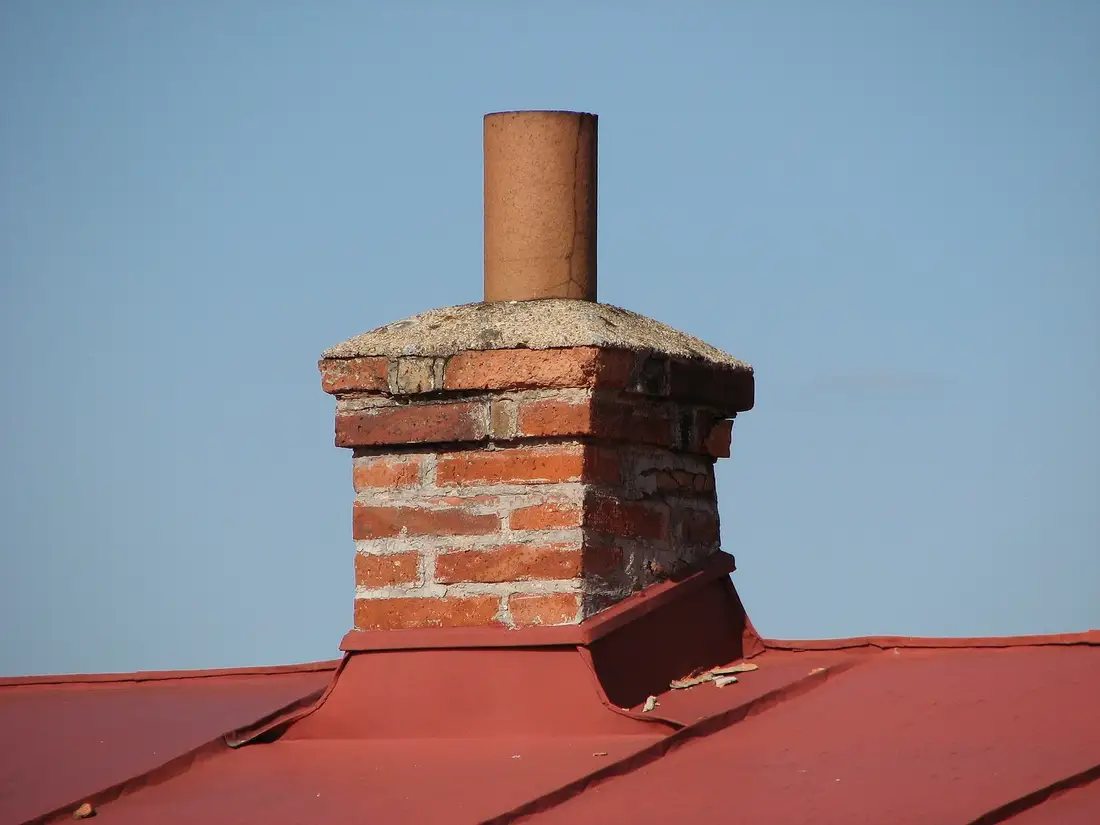
A full set around the chimney: an apron on the low side, step and counterflashing on the sides, and a cricket or back pan on the high side.
Vent pipe boots
A metal or plastic base with a rubber collar that hugs a plumbing vent; the rubber is usually the first thing on a roof to crack.
Valley flashing
Metal or membrane down the inside corner where two roof slopes meet, which carries more water than any other part of the roof.
Kickout flashing
A small diverter at the bottom of a roof-to-wall joint that kicks water into the gutter instead of down the siding.
At the eaves and rakes, the metal edge is drip edge rather than flashing; see drip edge installation.
Signs Your Roof Flashing Needs Repair
Signs your roof flashing needs repair include water stains on the ceiling or wall near a chimney, skylight or roof-to-wall joint, rusted or lifted metal, thick caulk standing in for real flashing, and cracked rubber around vent pipes.
If you can see daylight or wet wood around a chimney from the attic, the flashing has already let water in for a while. If the skylight itself is old, cracked or fogged, replacing it may make more sense; see skylight installation and replacement.
- Ceiling stains near the chimney, a skylight or where a lower roof meets a wall
- Rusted, bent or loose metal at the chimney or walls
- Gobs of caulk or roof cement where metal flashing should be
- Cracked or split rubber collars on vent pipes
- Water streaks on siding below the end of a roof-to-wall joint
- Damp or darkened wood around penetrations in the attic
Leak hunting
Check the joints
Look at every penetration above a stain before blaming the shingles.
Seeing these signs?
Our local roofer will look at your roof and tell you what it needs. Send a few details or call (651) 427-2051.
What Roof Flashing Repair Costs
Roof flashing repair costs about $200 to $500 by one national estimate and $200 to $600 by another. These are national ranges, not a quote.
Chimneys are the wide range. A reseal is a small job, while rebuilding the flashing on a large chimney with a cricket is much more work. The roofer prices it after seeing the chimney.
Flashing and related leak repairs, national ranges
Per repairHow a Roofer Repairs Flashing
A roofer repairs flashing by finding where the water actually gets in, lifting or removing the shingles around that joint, replacing or resealing the flashing, and re-laying the shingles so each course laps over it again.
- 1
Trace the leak
The roofer checks the attic and the roof above the stain to find the real entry point, which may be uphill from where the water shows.
- 2
Open up the joint
Shingles around the flashing are lifted or removed so the old metal and the deck under it can be seen.
- 3
Replace or reseal
Rusted or wrong-sized pieces are replaced, step flashing is rewoven with the shingles, and counterflashing is reset into the masonry where needed.
- 4
Close it up
Shingles go back down over the new flashing, and any soft decking found along the way is replaced; see roof decking replacement.
If you are not yet sure the flashing is the cause, start with roof leak repair, which covers tracing a leak in general.
Want our local roofer to take a look?
Send a few details or call (651) 427-2051, and our local roofer will come and look.
Flashing Rules During a North Branch Reroof
During a North Branch reroof, the city's final inspection requires that all roofing and flashing be in place. Kickout flashing is not required unless the house is being resided at the same time.
A roof replacement is the natural time to redo flashing, since the shingles around it are coming off anyway. Reusing old step flashing that is rusted or bent saves little and puts a weak joint under a brand-new roof.
Flashing also works with the ice and water shield, which Minnesota requires at the eaves; at walls and chimneys the membrane often runs up under the flashing as a second line of defense.
North Branch final inspection
Flashing in place
The city checks that all roofing and flashing is finished at the final.
Roof Flashing Repair FAQs
Can flashing be repaired without replacing the roof?
Yes. Flashing repair is usually a local job: the roofer opens the shingles around one chimney, wall or vent, fixes the flashing and closes it back up, without touching the rest of the roof.
Is caulk a good fix for leaking flashing?
Not for long. Caulk and roof cement can stop a drip for a season, but they crack with sun and freeze-thaw cycles. Metal flashing lapped correctly with the shingles is the lasting fix.
Should the flashing be replaced with a new roof?
Usually, yes. Step flashing and vent boots are cheap compared with the roof, and replacing them while the shingles are off avoids tearing into a new roof later. The roofer can tell you if any existing metal is sound enough to keep.
Is kickout flashing required in North Branch?
Not during a reroof alone. In North Branch, kickout flashing is not required during reroofing unless residing is done at the same time. It still keeps water off the siding.
How much does flashing repair cost?
About $200 to $600, a national range and not a quote. A chimney that needs new flashing all the way around costs more. Our local roofer prices the job after seeing it.
Get a flashing repair estimate
Tell us where the stain or leak shows up and what is on the roof above it, such as a chimney, skylight or vent. We pass it to our local roofer, who inspects the flashing and prices the repair.
Call now (651) 427-2051 Roofing in North Branch and the towns around it